

OpenRouter Alternatives: 7 LLM Gateways Compared on Routing, Pricing and Lock-In
 Anna
Table of contents:
Your app spent $10,000 on models through OpenRouter last month. The 5.5% credit fee added roughly $550 on top.
Then a security review asks where your prompts go, and the answer is "through someone else's servers."
That's usually when teams start comparing OpenRouter alternatives.
Most of them fix one of four things: how requests are routed, how you're charged, what enterprise controls you get, or how hard it is to leave.
This guide puts seven LLM gateways side by side on exactly those four, using only what each vendor documents publicly.
🚀 Quick Answer:
The best OpenRouter alternative depends on what you want to change. To cut fees, Vercel AI Gateway and TrueFoundry charge no token markup, and Cloudflare AI Gateway's core features are free.
To gain control, LiteLLM and Portkey run on your own infrastructure.
To keep a hosted, OpenAI-compatible endpoint, Requesty is the closest like-for-like router, and ScriptRun adds workflow automation on the same key.
-
Lowest fees: Vercel AI Gateway (no markup, including bring-your-own-key) or TrueFoundry (pay per seat, not per token).
-
Most control: LiteLLM (MIT license, 100+ providers) or Portkey's open-source gateway.
-
Compliance-heavy teams: Portkey Enterprise lists SOC 2, ISO 27001, GDPR and HIPAA; TrueFoundry lists SOC 2 Type II, GDPR and HIPAA programs.
-
Hosted router, different vendor: Requesty (600+ models, 5% markup on token prices, EU gateway in Frankfurt).
-
API plus workflows: ScriptRun (50+ models through one OpenAI-compatible key).
Why teams look for an OpenRouter alternative
OpenRouter earns its popularity, and it's the baseline every option below is measured against.
| OpenRouter | What it documents |
|---|---|
| Catalog | 600+ models from 80+ providers through one OpenAI-compatible key |
| Routing | Load balancing that favors lower prices and providers without recent outages; provider order and sort controls; a models list for fallbacks; an Auto Router |
| Pricing | Inference at provider list price, plus a 5.5% fee on credit purchases (Standard) or 8% (Business); Enterprise by contract |
| Bring your own key | No fee on the first $25,000 of list-price inference a month, then 5% |
| Free use | 25+ free models; 20 requests per minute and 50 per day, or 1,000 a day after buying $10 of credits |
| Enterprise and security | SOC 2 Type II; SSO and SCIM; EU and US in-region routing; a DPA with SCCs; SLAs and invoicing |
| Data | Zero-data-retention routing on every plan; no training on customer data |
| Self-hosting | Not offered; managed service only |
So the reasons to switch are narrower than many lists suggest.
Teams usually leave over one of these:
-
A fee on every top-up. The 5.5% credit fee is small at $1,000 a month and noticeable at $50,000.
-
A ceiling on bring-your-own-key. Above $25,000 a month of BYOK usage, OpenRouter charges 5%.
-
No self-hosting. Every request passes through OpenRouter's managed service. For some regulated teams, that alone rules it out.
-
Different control needs. Some teams want per-team budgets, guardrails or an observability stack that another gateway handles better.
How we compared the 7 LLM gateways
An LLM gateway sits between your app and the model providers.
It gives you one API and handles keys, routing, logging and spend controls in the middle.
We judged four criteria.
Routing
Can the gateway retry another provider when one fails? Can it fall back to a different model?
Can it route traffic by rules you set? Some gateways also offer automatic routers that pick a model per prompt.
For most production apps, dependable failover matters more than clever model selection.
Pricing
Gateways charge in three ways, so any OpenRouter pricing comparison needs to account for all three:
-
A percentage of spend: OpenRouter's 5.5% credit fee, Requesty's 5% markup on token prices, and Cloudflare's 5% fee on Unified Billing credits.
-
No token markup: Vercel and TrueFoundry. You pay for add-ons, seats or request volume instead.
-
Self-hosted: LiteLLM and Portkey's open-source gateway cost nothing to license, but you pay for the servers and the people who run them.
Model your real monthly spend rather than comparing headline percentages.
Our guide to LLM API cost optimization covers the token side of the bill.
Enterprise and security
We checked for SSO, published compliance attestations (SOC 2, ISO 27001, HIPAA), data residency options, audit logs and data retention controls.
A certification on a vendor's page tells you a program exists.
It doesn't replace reading the report, so request it through the vendor's trust center before you sign.
Lock-in
Four things decide how easy it is to leave: OpenAI compatibility (does switching mean changing only the base_url and key?), a self-hosting path, bring-your-own-key support, and who stores your logs and keys.
Every gateway also adds a network hop, so measure it alongside your other sources of API latency.
Which OpenRouter alternative fits your needs
There's no single best LLM gateway. This table pulls the key facts from each entry below so you can shortlist quickly.
| Gateway | Type | Pricing model | Free option | Routing highlights | Enterprise and compliance (documented) | Self-host | Lock-in risk | Best for |
|---|---|---|---|---|---|---|---|---|
| OpenRouter (baseline) | Hosted router | 5.5% fee on credits; BYOK free to $25K/month, then 5% | 25+ free models | Price and uptime balancing, fallbacks, Auto Router | SOC 2 Type II, SSO/SCIM, EU and US routing | No | Medium | Breadth with no setup |
| ScriptRun Open API | Hosted API + workflows | Prepaid SR tokens (1 SR = $0.01), per-model prices | Free plan, 250 SR | Provider failover, retries, smart routing | Per-project keys and quotas; data terms by agreement; no certifications listed | No | Medium | Models plus workflow automation |
| Requesty | Hosted router | 5% markup on token prices | Free tier | Policies, fallbacks, caching | SSO (SAML/OIDC), GDPR DPA, EU gateway; SOC 2 Type II in progress | No | Medium | Like-for-like OpenRouter swap |
| Vercel AI Gateway | Hosted gateway | No token markup; paid add-ons | Monthly free credit | Provider retries, model fallbacks, budgets | Vercel SOC 2 Type 2, ISO 27001, HIPAA BAA; ZDR by default | No | Low to medium | Cost-sensitive teams |
| Cloudflare AI Gateway | Edge gateway | Free core; 5% on Unified Billing credits | Free core features | Dynamic Routing, Auto Router (both beta) | DLP and Guardrails (beta); logging can be switched off | No | Medium | Caching and rate limits at the edge |
| LiteLLM | Open-source gateway | Free (MIT); paid Enterprise license | Free to self-host | Routing, fallbacks, load balancing | SOC 2 Type II audited; SSO, SCIM, audit logs on Enterprise | Yes | Low | Full control |
| Portkey | Open source + hosted | Free OSS; hosted $0 or $49/month; Enterprise custom | Dev plan, 10K requests/month | Fallbacks, load balancing, conditional routing | SOC 2, ISO 27001, GDPR, HIPAA; SSO; VPC or hybrid (Enterprise) | Yes | Low | Detailed routing rules |
| TrueFoundry AI Gateway | Enterprise gateway | No token markup; $25/user/month on Pro | Developer plan, up to 3 users | Virtual model groups, budgets, guardrails | SOC 2 Type II, GDPR, HIPAA; SSO/SAML/OIDC; VPC or on-prem (Enterprise) | Enterprise only | Medium | Governed, multi-team platforms |
Prices, limits and features as published on each vendor's site on November 4, 2026. Lock-in risk is our assessment based on self-hosting, BYOK and OpenAI compatibility.
The 7 best OpenRouter alternatives
Each entry opens with a short summary, then a fact table with the same rows for every gateway, so you can compare the OpenRouter alternatives line by line.
1. ScriptRun Open API
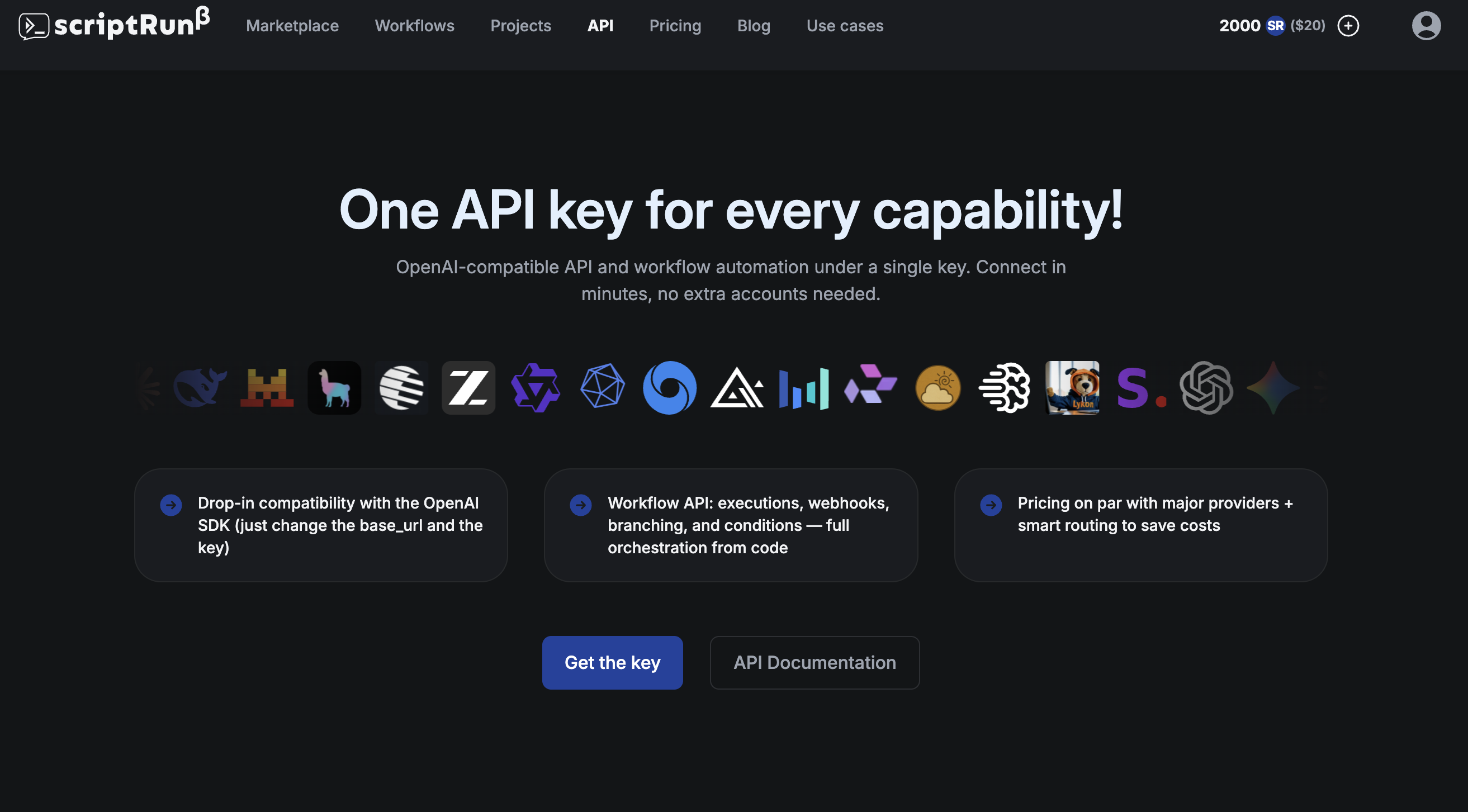
ScriptRun gives you one OpenAI-compatible key for 50+ models, including GPT, Claude, Llama and Mistral.
Existing OpenAI SDK code switches over when you change the base_url and key; our guide shows how to point your OpenAI SDK at ScriptRun.
The same account also runs visual AI workflows that you can start through an API.
| ScriptRun Open API | Details |
|---|---|
| Type | Hosted, OpenAI-compatible API plus a Workflow API |
| Routing | Smart routing; automatic switching and failover between providers; retries with backoff; request-level idempotency |
| Pricing | Prepaid SR tokens: Free $0 (250 SR, about 75 API requests). Each model has its own price per 1,000 tokens on the per-model prices page |
| API coverage | Chat completions, embeddings, vision, tool calling and streaming |
| Enterprise and security | Per-project keys, limits and quotas; separate keys and reports for resellers; data storage and processing terms set by agreement. No SSO or compliance certifications are listed on public pages |
| Self-hosting | Not documented |
| Lock-in | Medium. Standard OpenAI request schemas keep switching cheap, but the service is hosted only |
| Best for | Teams that want ScriptRun's OpenAI-compatible API for several models plus workflow automation on one account |
| Watch out for | SR-token pricing takes a minute to compare with providers' dollar list prices; regulated teams should ask about data terms before rollout |
2. Requesty
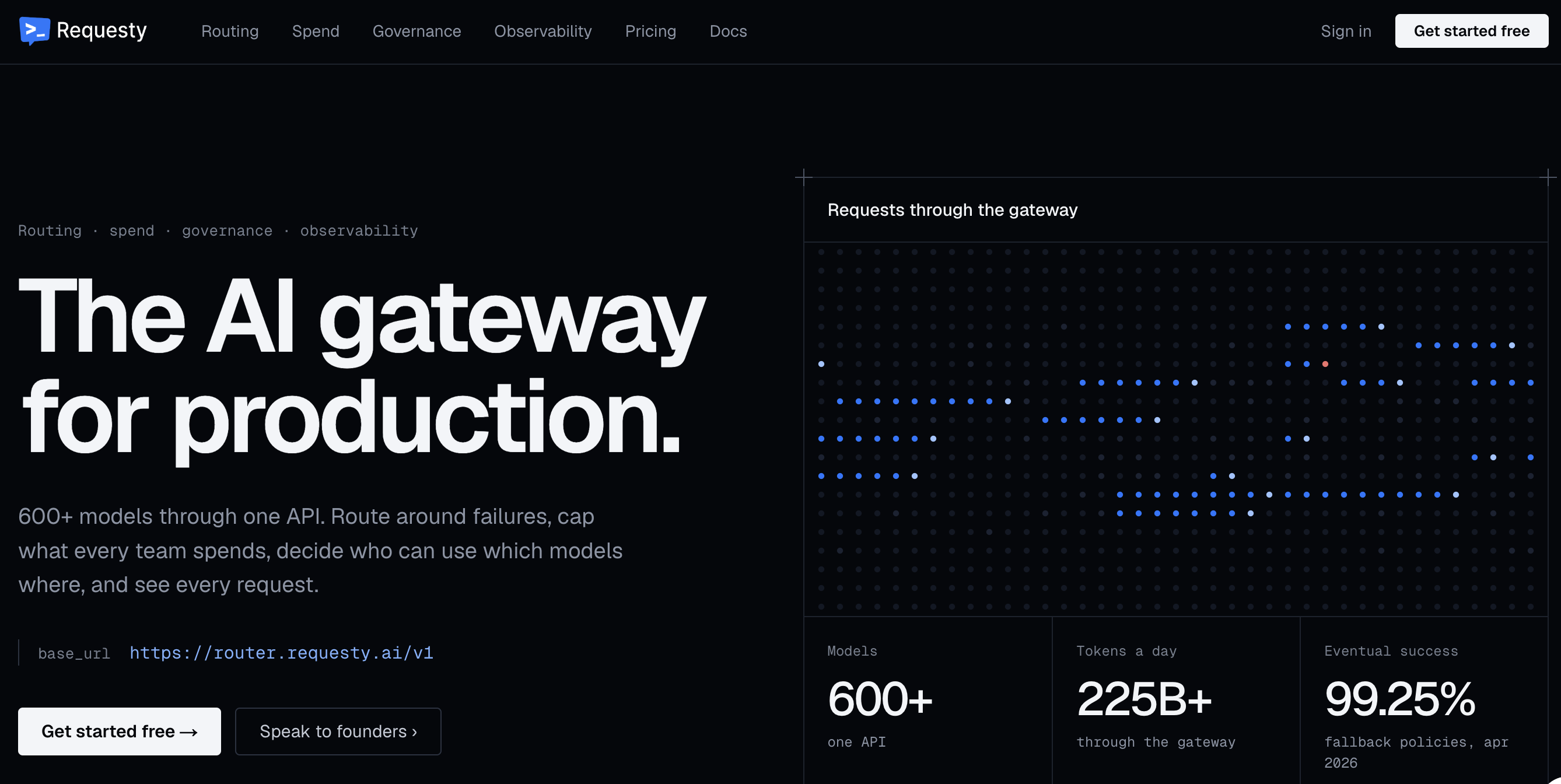
Requesty is the closest like-for-like OpenRouter alternative: a hosted router with 600+ models, bring-your-own-key support and a free tier that needs no card.
The fees work differently, though.
Requesty's 5% applies to tokens, while OpenRouter's 5.5% applies when you buy credits, so which comes out cheaper depends on your usage and whether you bring your own keys.
| Requesty | Details |
|---|---|
| Type | Hosted router |
| Routing | Routing policies, fallbacks and caching; smart routing can send simpler tasks to cheaper models |
| Pricing | Pay as you go adds a 5% markup to each provider's per-token price, with no platform, seat or minimum fees; Enterprise custom |
| Enterprise and security | SSO with SAML and OIDC (Okta, Azure AD, Google Workspace) on Enterprise; GDPR Article 28 DPA on request; always-on, exportable audit logs; PII redaction and zero data retention per policy. SOC 2 Type II is listed as in progress |
| Data residency | EU gateway in Frankfurt (eu-central-1) |
| Self-hosting | Not offered |
| Lock-in | Medium. Hosted only, with BYOK available |
| Best for | Teams happy with OpenRouter's model who want to test another router, especially with EU routing needs |
| Watch out for | You still pay a percentage of spend, and SOC 2 isn't complete yet |
3. Vercel AI Gateway
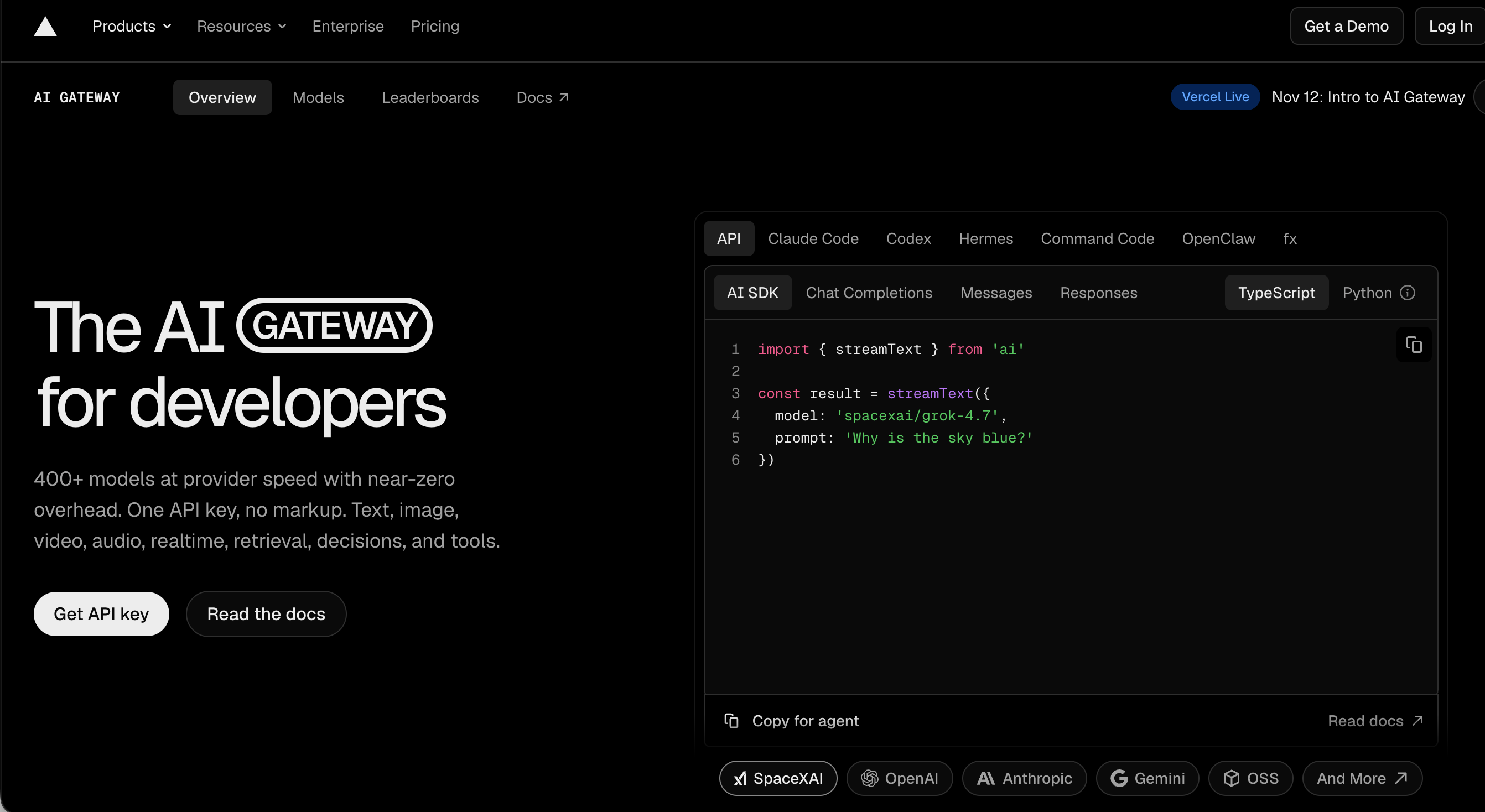
Vercel's AI Gateway charges no markup and no platform fee on tokens, including requests made with your own keys.
You don't have to host on Vercel: an API key works from any environment, and existing OpenAI or Anthropic SDKs connect by changing the base URL.
| Vercel AI Gateway | Details |
|---|---|
| Type | Hosted gateway |
| Routing | Failed requests are retried across the model's other providers; configurable model fallbacks; budgets per team, project, key or user |
| Pricing | Provider list prices with no token markup. Payment processing fees apply. Paid add-ons include team-wide zero data retention or a provider allowlist at $0.10 per 1,000 requests. Purchased credits expire after one year |
| Free option | A monthly free credit on a subset of models, with lower rate limits |
| Enterprise and security | Zero data retention by default at the gateway; per-request routing only to providers with verified ZDR agreements; a provider allowlist on Pro and Enterprise. Company-wide: SOC 2 Type 2, ISO 27001, and HIPAA BAAs for eligible Pro and Enterprise customers |
| Self-hosting | Not offered |
| Lock-in | Low to medium. BYOK and standard SDKs keep exit costs down |
| Best for | Cost-sensitive teams, especially those already on Vercel |
| Watch out for | BYOK requires purchased credits. If a request using your key fails, Vercel can retry it with its own credentials and charge your credits |
4. Cloudflare AI Gateway
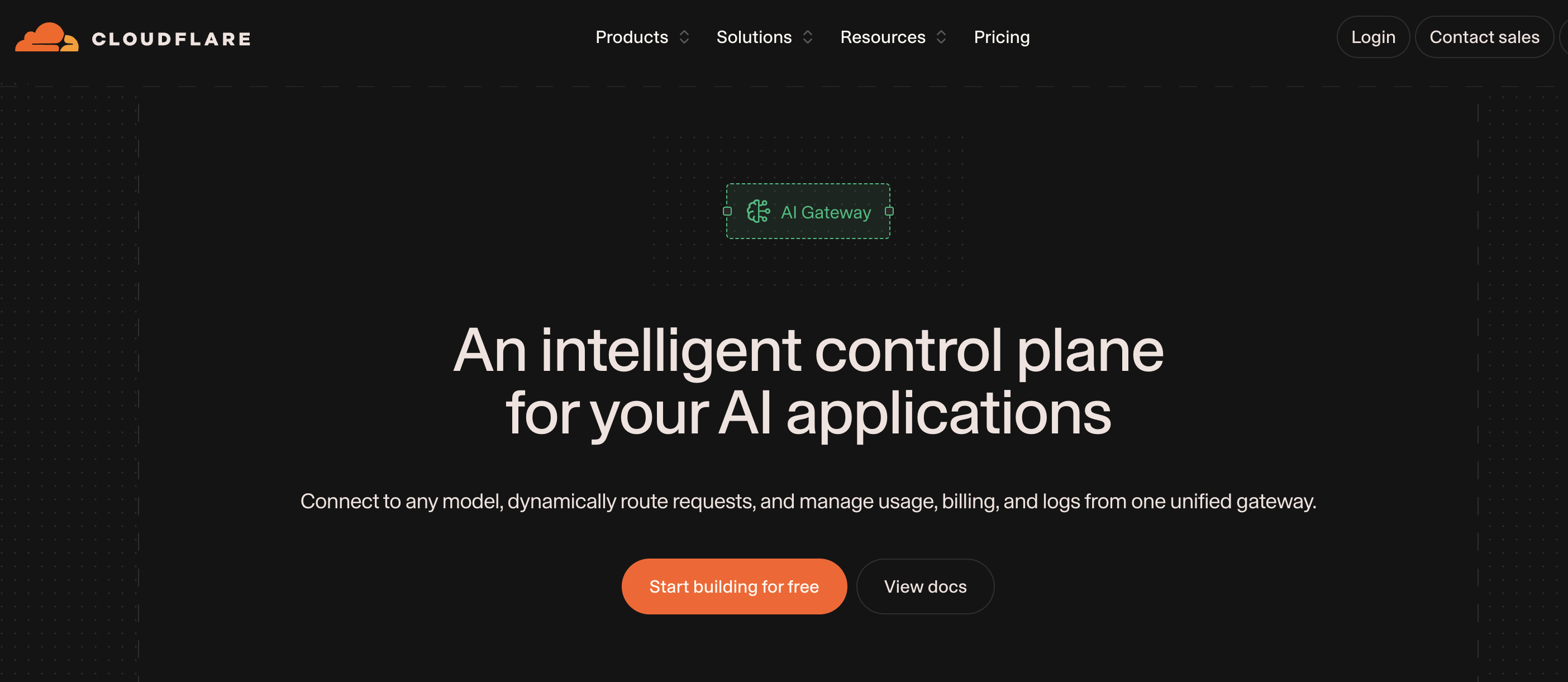
Cloudflare's gateway runs on its global network and focuses on control: analytics, caching, rate limiting and spend limits. Its core features are free.
Several of the features that matter most to OpenRouter switchers are still labeled beta in Cloudflare's docs, so test them before you depend on them.
| Cloudflare AI Gateway | Details |
|---|---|
| Type | Edge gateway |
| Routing | Dynamic Routing for fallbacks and an Auto Router, both in beta; caching and rate limiting |
| Pricing | Core features free. Bring your own keys at no gateway fee (BYOK is in beta), or use Unified Billing: buy Cloudflare credits and call providers such as OpenAI, Anthropic and Google AI Studio without their keys. Unified Billing adds 5% to credit purchases ($100 of credit costs $105), with no markup on inference |
| Enterprise and security | Data Loss Prevention scans prompts and responses and can flag or block them; Guardrails; both in beta. Logging is on by default but can be turned off for the gateway or per request. Log retention follows Workers Logs for gateways created on or after September 24, 2026 |
| Providers | 20+ |
| Self-hosting | Not offered |
| Lock-in | Medium. The older OpenAI-compatible Unified API is marked deprecated in the docs, so check the recommended endpoint before migrating OpenAI SDK code |
| Best for | Teams already on Cloudflare who want caching and rate limits close to users |
| Watch out for | A shorter provider list than the big aggregators, and key features still in beta |
5. LiteLLM
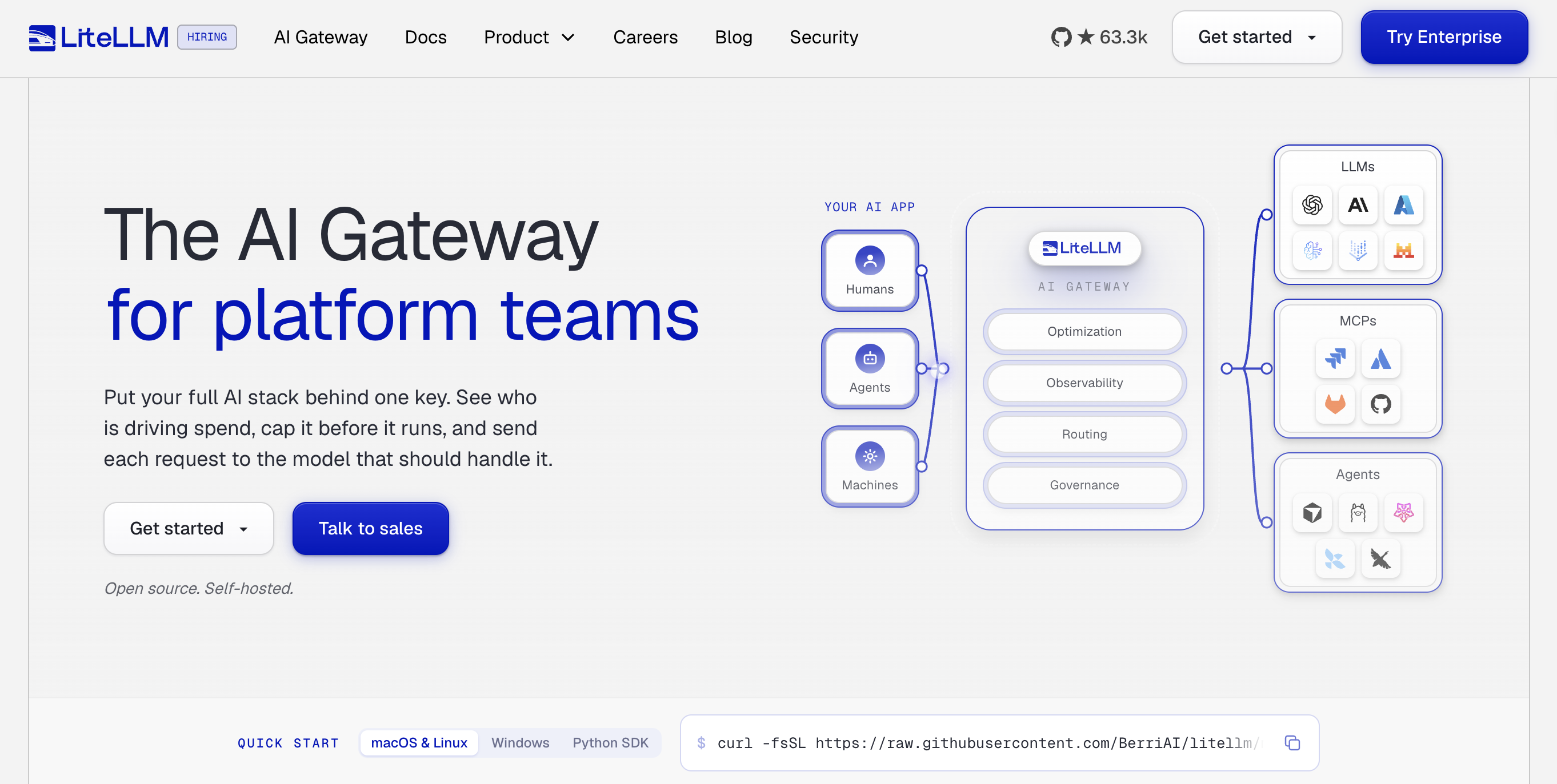
LiteLLM is the open-source answer: an MIT-licensed Python SDK plus a self-hosted AI gateway that reaches 100+ providers through one OpenAI-format API.
People searching for LiteLLM alternatives are usually weighing the same trade-off from the other side: control versus operating work.
| LiteLLM | Details |
|---|---|
| Type | Open-source, self-hosted gateway |
| Routing | Routing, fallbacks and load balancing, plus an optional Auto Router add-on; virtual keys, budgets and rate limits |
| Pricing | Free to run; you pay providers and your own infrastructure. An Enterprise license is priced by deployment and usage, with a 30-day trial |
| Enterprise and security | SOC 2 Type II audited, per LiteLLM's compliance page. Enterprise adds SSO beyond five users, SCIM, audit logs and support SLAs. Self-hosted, so your data stays in your environment |
| Self-hosting | Yes (pip or Docker) |
| Lock-in | Low, because it runs in your environment with your keys |
| Best for | Platform teams that want full control |
| Watch out for | You run it, monitor it and patch it, including its dependencies |
Self-hosting also makes supply-chain security your job. In March 2026, two versions of the litellm package on PyPI (1.82.7 and 1.82.8) were compromised with credential-stealing code.
According to the maintainer, the official Docker image, which pins versions, wasn't affected (NetSPI). Pin your versions, and rotate keys if you installed either release.
6. Portkey
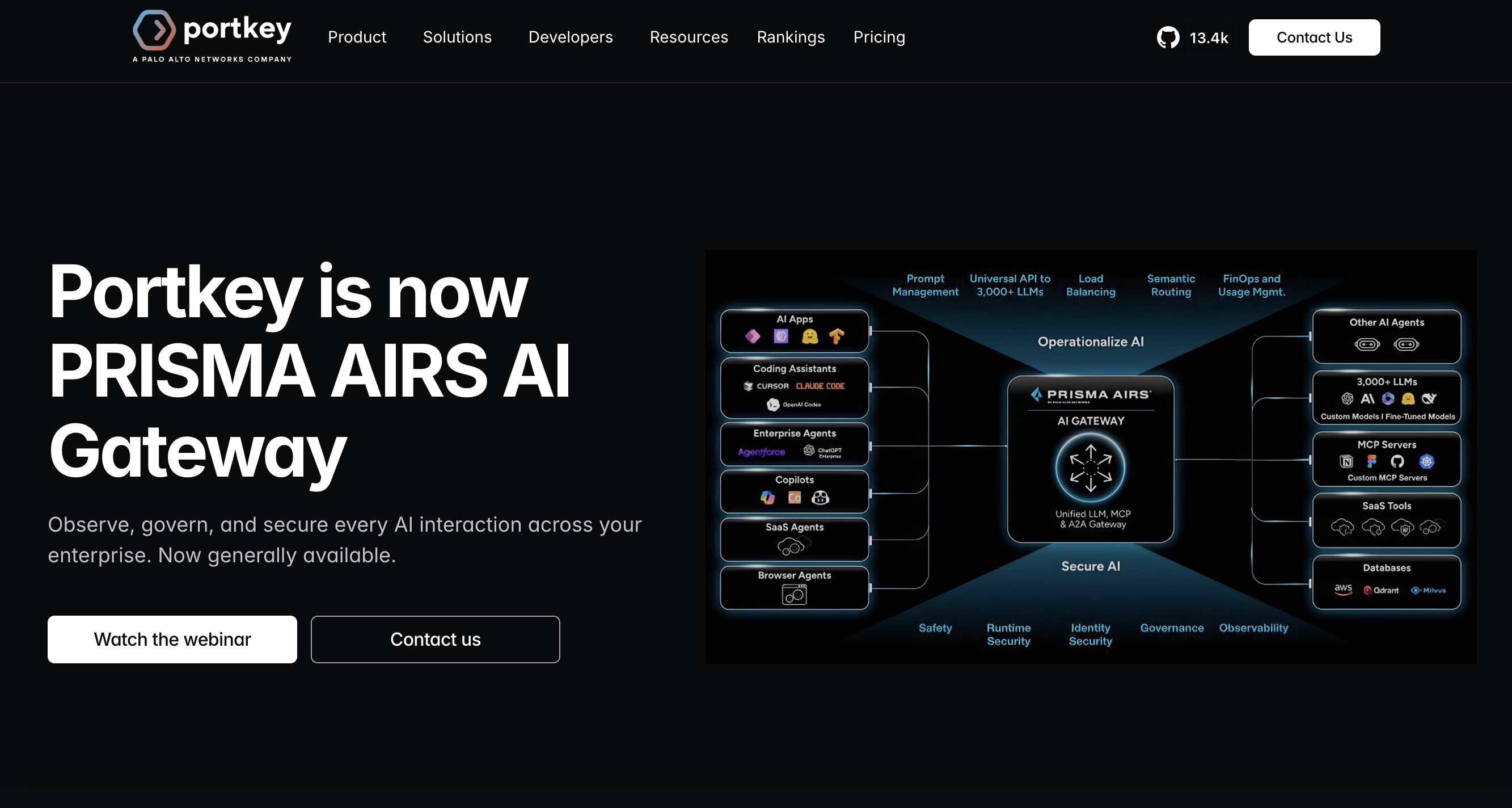
Portkey offers both routes: an open-source gateway you can self-host with no request limit, and hosted plans with logging and governance.
That makes it one of the few options where you can start hosted and move in-house later without switching vendors.
| Portkey | Details |
|---|---|
| Type | Open-source gateway plus hosted plans |
| Routing | Automatic fallbacks, load balancing, conditional routing, automatic retries and request timeouts |
| Pricing | Dev: free for 10,000 requests a month, 3-day log retention. Pro: $49 a month for 100,000 requests, plus $9 per extra 100,000 up to 3 million, 30-day retention. Enterprise: custom |
| Enterprise and security | Enterprise lists SOC 2, ISO 27001, GDPR and HIPAA compliance; SSO with Okta; audit logs; advanced role-based access control; configurable retention periods; bring your own encryption key |
| Self-hosting | Yes: the open-source gateway, plus VPC-managed hosting or a hybrid deployment on Enterprise |
| Lock-in | Low, because you can move from hosted to self-hosted |
| Best for | Teams that want detailed routing rules and a path to self-hosting |
| Watch out for | Logs on the free plan last three days, and hosted costs grow with request count |
7. TrueFoundry AI Gateway
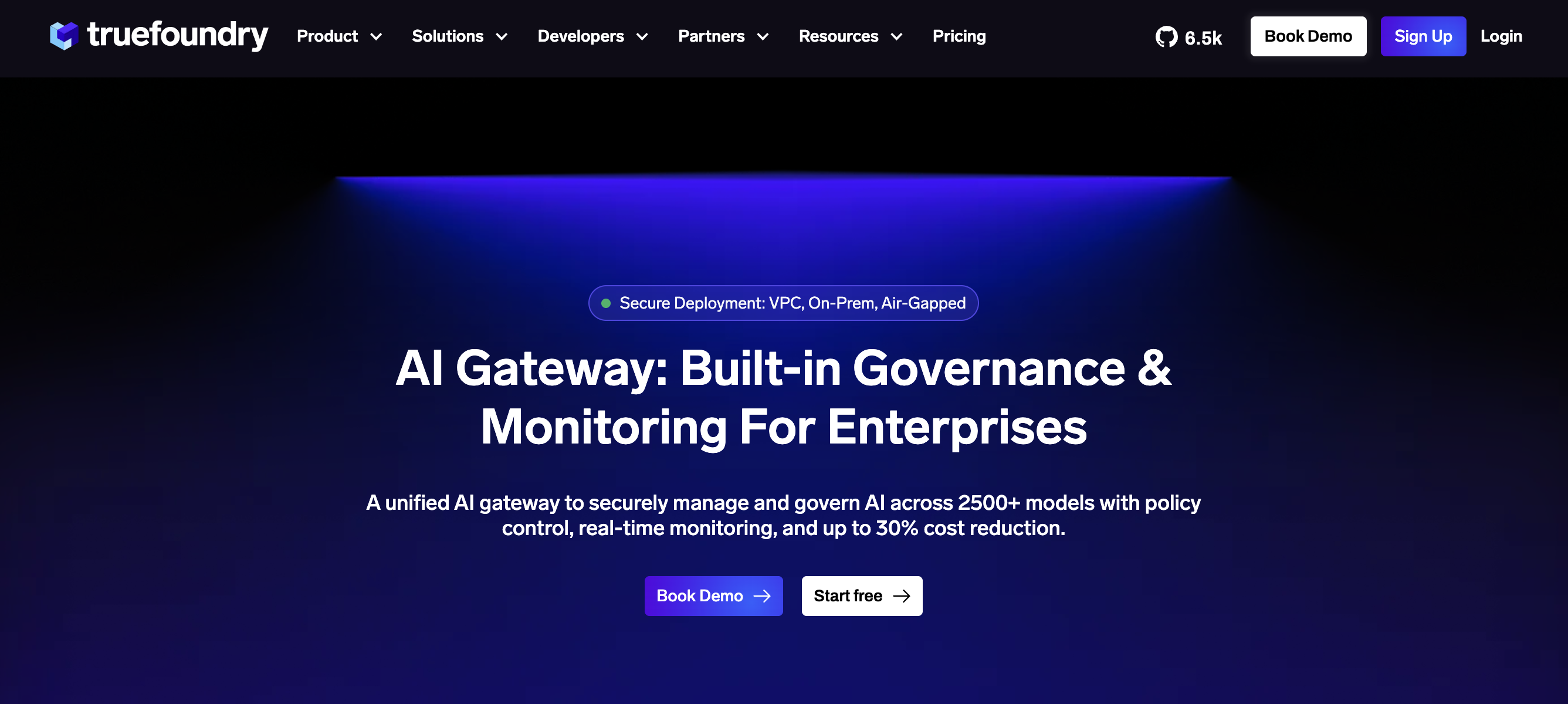
TrueFoundry is built for enterprise platform teams. It doesn't mark up tokens; you pay per seat and for request volume, and the governance features are the main draw.
| TrueFoundry AI Gateway | Details |
|---|---|
| Type | Enterprise gateway with an MCP gateway |
| Routing | Virtual model groups, budget rules and guardrails |
| Pricing | Developer: free for up to 3 users, 10,000 requests per user a month, 7-day logs. Pro: $25 per user a month, 20,000 requests per user pooled across the team, $20 per extra 100,000 requests, 30-day logs. Enterprise: custom |
| Enterprise and security | SOC 2 Type II, GDPR and HIPAA programs for its SaaS; SSO with SAML or OIDC, RBAC and teams; AES-256 encryption at rest; a choice of region for the gateway and logs, or your own S3, Azure Blob or GCS storage; DPAs available |
| Self-hosting | VPC and on-prem deployment on Enterprise only |
| Lock-in | Medium. SaaS on every plan, with self-hosting reserved for Enterprise |
| Best for | Companies standardizing many teams on one governed gateway |
| Watch out for | Seat pricing suits large teams better than small teams with high request volume |
OpenRouter vs LiteLLM: managed marketplace or self-hosted proxy
The OpenRouter vs LiteLLM question comes up more than any other comparison, because the two sit at opposite ends of the lock-in scale.
| OpenRouter | LiteLLM | |
|---|---|---|
| Hosting | Managed service | You run it (Docker or pip) |
| Fees | 5.5% on credits (Standard); BYOK free up to $25,000/month, then 5% | Free MIT license; you pay providers and infrastructure |
| Model access | 600+ models from 80+ providers through OpenRouter's accounts | 100+ providers through your own keys |
| Setup | An API key in minutes | Deploy, configure and maintain a gateway |
| Compliance | SOC 2 Type II; EU and US in-region routing on Enterprise | SOC 2 Type II audited; data stays in your environment |
| Security responsibility | Mostly OpenRouter's | Yours, including dependency updates |
Choose OpenRouter:
when you want breadth fast and don't want to run infrastructure.
Choose LiteLLM:
when data must stay in your environment, when your spend makes percentage fees painful, or when you already run platform services.
In the LiteLLM vs OpenRouter decision, the hidden cost is people: someone has to own upgrades, monitoring and key rotation.
BYOK: does bringing your own keys make OpenRouter cheaper
Often, yes, up to a point. With BYOK on OpenRouter, you pay providers directly, and OpenRouter charges no fee on the first $25,000 of list-price inference each month. Above that, it charges 5% (pricing).
Here's an illustrative example. These are not quotes, and the example assumes the 5% applies only to usage above the cap.
| Monthly inference | Through OpenRouter credits (5.5%) | With BYOK on OpenRouter |
|---|---|---|
| $10,000 | About $550 in fees | $0 (under the cap) |
| $25,000 | About $1,375 | $0 (at the cap) |
| $40,000 | About $2,200 | About $750 (5% of $15,000) |
Other gateways handle BYOK differently:
| Gateway | BYOK terms |
|---|---|
| Vercel AI Gateway | No BYOK fee, but you need purchased credits to use it |
| Cloudflare AI Gateway | No gateway fee for BYOK (in beta); the 5% applies only to Unified Billing credits |
| Requesty | BYOK included in pay as you go |
| LiteLLM and Portkey OSS | Always your own keys; no gateway fee |
If your spend is steady and you already hold provider contracts, BYOK is usually the first lever to pull, before you switch gateways at all.
How to switch from OpenRouter without breaking your app
Most alternatives to OpenRouter accept OpenAI-format requests, so the code change is small. With the OpenAI Python SDK, it's usually two lines:
from openai import OpenAI

# Before: OpenRouter
client = OpenAI(base_url="https://openrouter.ai/api/v1", api_key=OPENROUTER_API_KEY)

# After: the new gateway's OpenAI-compatible endpoint (see its docs)
client = OpenAI(base_url=NEW_GATEWAY_BASE_URL, api_key=NEW_GATEWAY_API_KEY)
The risk sits in the details around that change:
-
Inventory what you use. List the models, streaming, tool calls, vision, structured outputs and any OpenRouter-specific parameters such as models fallbacks or provider order.
-
Map model IDs. Every gateway names models slightly differently.
-
Change the base_url and key, and keep your OpenAI SDK. For ScriptRun, follow the Chat Completions API guide.
-
Recreate routing. Rebuild fallbacks, provider preferences and budgets in the new gateway's own format.
-
Recheck data settings. Turn on the new gateway's equivalents of zero data retention, provider allowlists and log controls before real traffic flows.
-
Test the edges. Check streaming, tool calls, timeouts and error codes (429, 5xx) with real prompts.
-
Run both for a week. Compare cost per 1,000 requests, latency and failure rates on the same traffic.
-
Keep OpenRouter as a fallback until the new setup is stable, then remove it.
Which OpenRouter alternative should you choose
Start with whichever criterion hurts most today.
| If your priority is… | Shortlist |
|---|---|
| Lower fees on high spend | Vercel AI Gateway or TrueFoundry (try BYOK on OpenRouter first) |
| Data must stay in your environment | LiteLLM, Portkey's open-source gateway, or TrueFoundry Enterprise |
| Formal compliance (SOC 2, HIPAA) | Portkey Enterprise, TrueFoundry, or Vercel AI Gateway |
| EU data routing | Requesty's Frankfurt gateway, or OpenRouter Enterprise's EU routing |
| Already on Cloudflare | Cloudflare AI Gateway |
| An OpenRouter-style hosted router | Requesty |
| Starting for free | Self-hosted LiteLLM, plus free tiers from Vercel, Portkey, TrueFoundry and ScriptRun |
| One API for models and workflows | ScriptRun |
The free picks above are the practical OpenRouter alternatives for free use, though providers still bill for tokens.
Whichever you shortlist, run a week of real traffic through it before you move everything.
If a hosted, OpenAI-compatible endpoint that also runs AI workflows fits your team, try ScriptRun's Open API.


FAQs about OpenRouter alternatives
What is OpenRouter?
OpenRouter is a hosted API that routes your requests to hundreds of AI models through one OpenAI-compatible endpoint. According to its pricing page, it offers 600+ models from 80+ providers. It balances traffic across providers by price and uptime, and charges a fee when you buy credits.
Is OpenRouter safe?
OpenRouter says it holds a SOC 2 Type II report, doesn't train on customer data and offers zero-data-retention routing on every plan. Your prompts still pass through OpenRouter and the selected provider, so check both against your security and compliance requirements, and request the SOC 2 report before you sign.
Is OpenRouter open source?
No. OpenRouter runs as a managed service and doesn't offer a self-hosted or open-source version of its router. If open source matters to you, LiteLLM (MIT license) and Portkey's open-source gateway are the usual choices.
Is OpenRouter cheaper than OpenAI?
Not for the same model. OpenRouter bills inference at the provider's list price, then adds a 5.5% fee when you buy credits on the Standard plan. With your own OpenAI key, OpenRouter charges no fee on the first $25,000 a month. It only saves money when routing moves work to cheaper models or providers.
Is OpenRouter private?
It can be configured for privacy. OpenRouter offers zero-data-retention routing on all plans and a setting that excludes providers that collect data, and it says it doesn't train on customer data. Enterprise plans add EU or US in-region routing. Without those settings, some providers may retain prompts under their own policies.
Can I use OpenRouter for free?
Yes, with limits. The free plan includes 25+ free models with no platform fee. Free models allow 20 requests per minute and 50 per day, rising to 1,000 a day once you've bought at least $10 of credits.
Does OpenRouter automatically route?
Yes. By default it balances requests across providers, favoring lower prices and avoiding providers with recent outages. You can override this with provider ordering or sorting, add a models list for fallbacks, or use its Auto Router to pick a model per prompt.
Is there a free alternative to OpenRouter?
Self-hosted LiteLLM and Portkey's open-source gateway are free to run; you pay only for providers and servers. Hosted options with free tiers include Vercel AI Gateway's monthly credit, Cloudflare AI Gateway's free core features, Portkey's Dev plan, TrueFoundry's Developer plan and ScriptRun's free plan.
Can I self-host an OpenRouter alternative?
Yes. LiteLLM and Portkey's open-source gateway both run on your own infrastructure, and TrueFoundry offers VPC and on-prem deployment on Enterprise plans. If you're comparing LiteLLM alternatives for self-hosting, budget time for upgrades and security. Pin package versions and rotate keys after any incident.
What is the difference between an LLM gateway and an LLM router?
An LLM gateway is the control layer between your app and model providers: keys, logging, budgets, retries and fallbacks. An LLM router is the part that decides which model or provider handles each request. Most gateways include some routing, and some routers come with gateway features.
Related posts
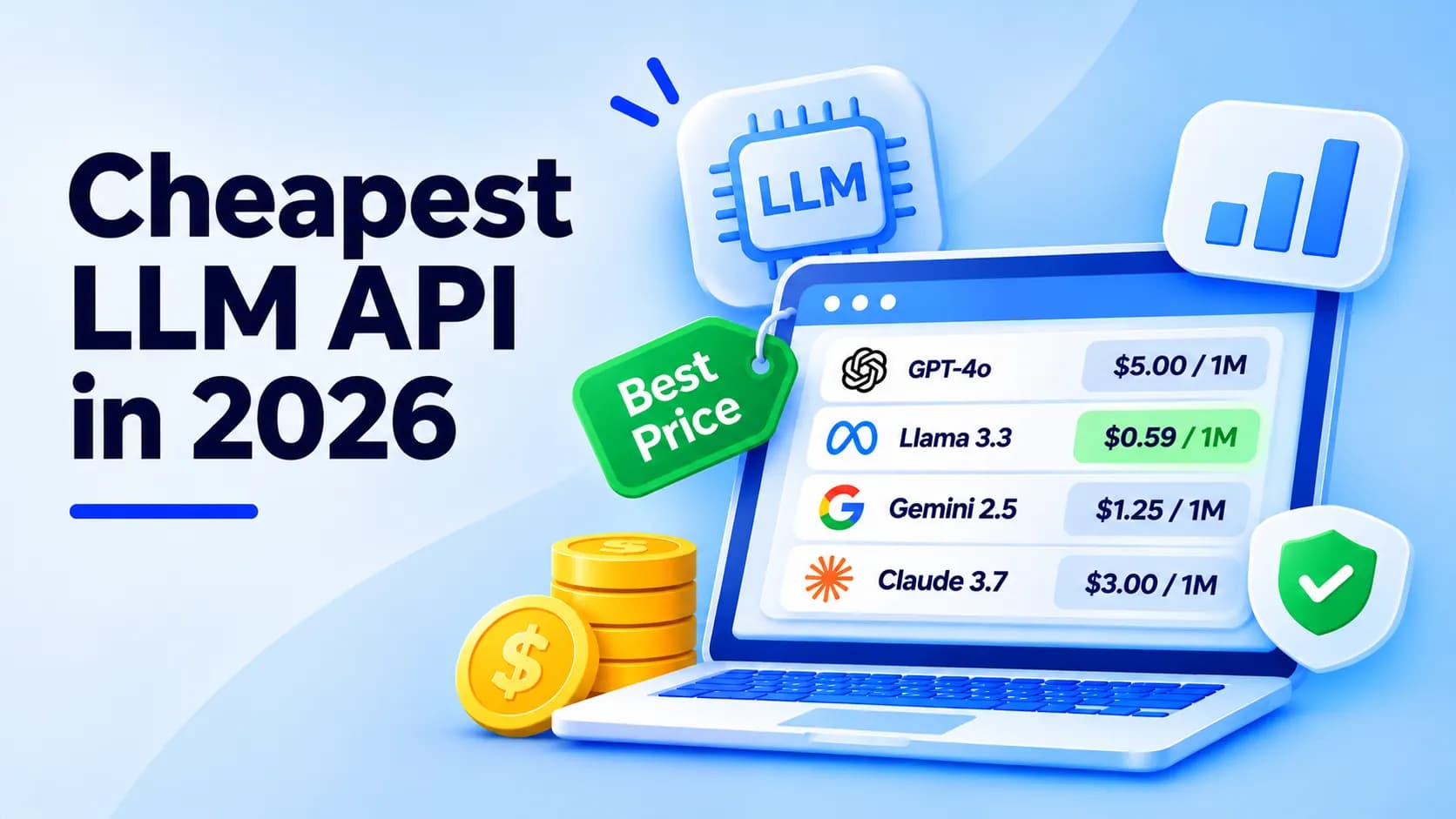
Cheapest LLM API 2026: Verified Prices per 1M Tokens
Which is the cheapest LLM API? Verified prices for OpenAI, Claude, Gemini, DeepSeek, Qwen, Mistral and Groq, plus real workload costs and hidden fees.
 Anna

AI Agent Marketplace: 10 Best Places to Find, Run and Sell AI Agents in 2026
What an AI agent marketplace is, 10 top platforms compared on cost to try and who can sell, a safety checklist, and how to list your own agent in 2026.
Anna
Free LLM API: Which Providers Are Still Free in 2026 (Limits, Keys and Catches)
Every free LLM API worth using in 2026, checked against official docs: free tiers vs credits, limits, data terms, how to get a key, and fallback code.
Anna
OpenAI Compatible API: What It Is, Who Supports It and How to Switch Safely
An OpenAI compatible API guide: base URLs for 15 providers, what breaks when you switch, a copy-paste smoke test and a safe migration checklist.
Anna